Time is a valuable but finite resource—and a rare one that is equally distributed. Young or old, employed or retired, we all have the same 24 hours in each day. How we spend those hours is powerfully shaped by culture, economics, and even public policy—by necessity, not solely by choice.
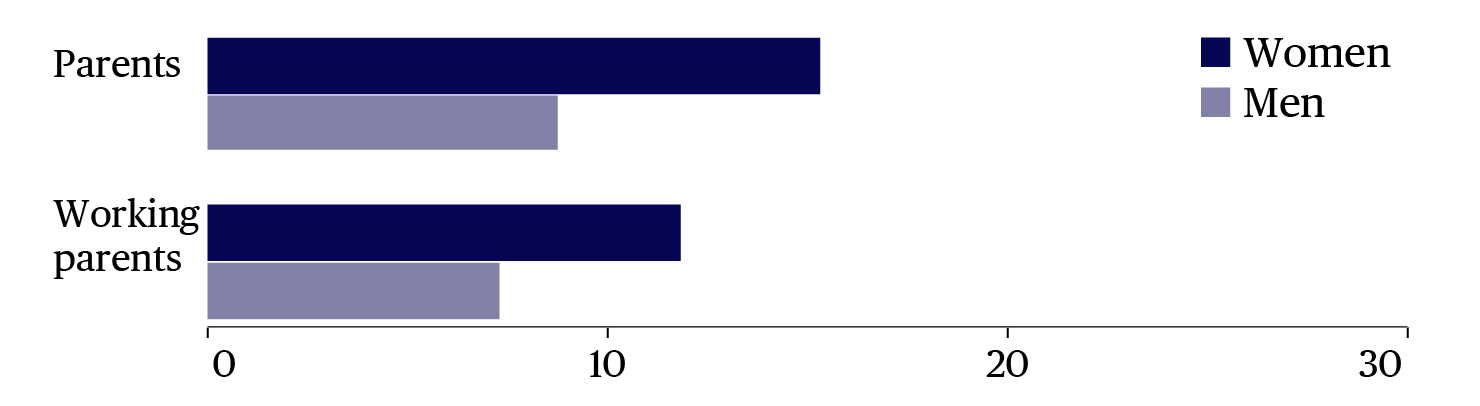
Care Work and the Free-Time Gender Gap in California examines how California adults divide their time between work, unpaid childcare and household work, free time, and all other activities. Analyzing American Time Use Survey (ATUS) data from 2021 through 2024, we find that women spend significantly more time than men taking care of children and doing housework like cooking, cleaning, and grocery shopping. Moreover, women in California spend more time on work than men, once unpaid childcare and household work in the home is added to the time spent in paid employment.
This imbalance in the division of unpaid labor in the home shapes how the remaining time can be spent, contributing to the free-time gender gap, a topic Gender Equity Policy Institute explored in our October 2024 report on U.S. adults overall.
These gender disparities are not simply the result of personal choice or individual family dynamics. How women and men spend time is influenced by deeply entrenched cultural norms and stereotypes about women’s role in society. The notion that women’s place is in the home persists despite profound changes in public opinion on gender and decades of progress toward gender parity in education, public life, the workplace, and other spheres.
Let us be clear. Household labor is necessary for health, well-being, and survival. Children must be cared for. Parenting is meaningful and often full of joy. Domestic labor, whether unpaid or paid, is enormously valuable. Without it, society would quite literally grind to a halt.
The problem is not the act of doing housework or childcare. The problem is that longstanding cultural norms systematically devalue domestic labor, whether done for free by family members or by people who are paid for their work. And it is devalued precisely because it is historically women’s work.
Public policy, unfortunately, plays an important role in sustaining these gendered patterns of inequality in domestic labor. The United States has a unique culture of overwork; American workers put in far more hours than those in other wealthy countries. Compared to other OECD countries, the U.S. invests less in childcare and is the only nation without any form of paid leave. The U.S. has the lowest women’s labor force participation rate of any of its peers, which research has directly linked to the absence of policies to support working families.
Gender equality in American society will remain elusive until women and men are truly equal in the home. Public policy can help accelerate progress, and California has been a national leader in this regard, as we discuss in the conclusion of this report.
Change will ultimately require cultural shifts in how we value the work of caring for children and homes and the people who do it. Policies designed to support families can nudge along cultural change toward a more balanced, fair, and equitable division of work in the home.