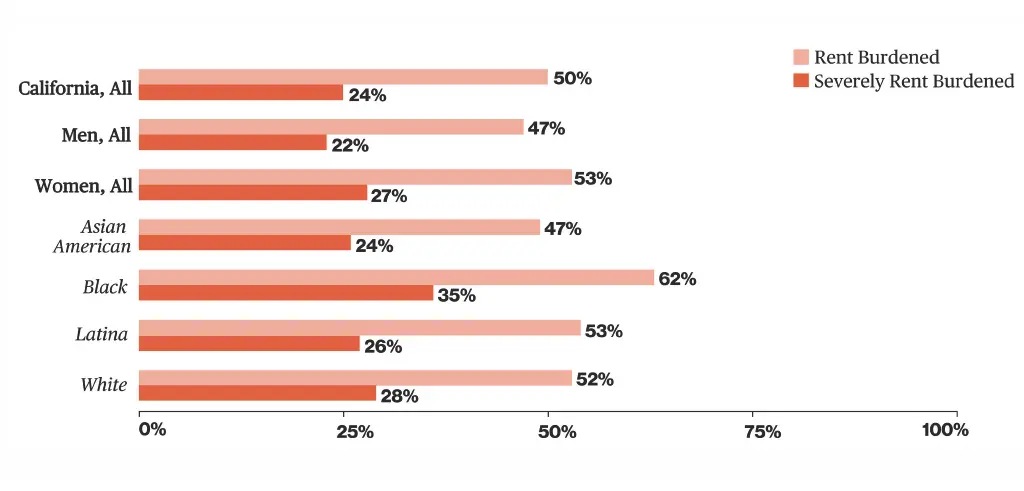
California’s housing crisis harms nearly every Californian, directly or indirectly. But women bear the heaviest burden from the state’s high cost of housing. Black women, senior women, single mothers, and women living alone are those most likely to be shouldering unaffordable housing costs. Simply being a woman makes one more likely to live in unaffordable housing, even when controlling for race/ethnicity, household income, and employment status.
The greater difficulty women face in securing affordable housing is deeply intertwined with gender inequality in the broader society. Lower pay, less accumulated wealth, and disproportionate responsibility for taking care of children disadvantages women in the housing market.
Nearly 14 million Californians, including 3.5 million children, live in housing considered unaffordable by standard measures. Roughly 6 million of these people live in owned homes, while roughly 7.8 million live in rentals. While the share of rent burdened Californians increased between 2019 and 2022, it was stable in the most recent year for which data is available (2023). Yet women remain consistently more likely than men to live in unaffordable homes.
Housing is considered unaffordable when more than 30 percent of household income goes toward housing costs, and those spending at this level are designated as “rent burdened”—or “cost burdened” if they are a homeowner. Those who spend more than 50 percent of their income on housing costs are designated as “severely rent burdened” or “severely cost burdened.”